
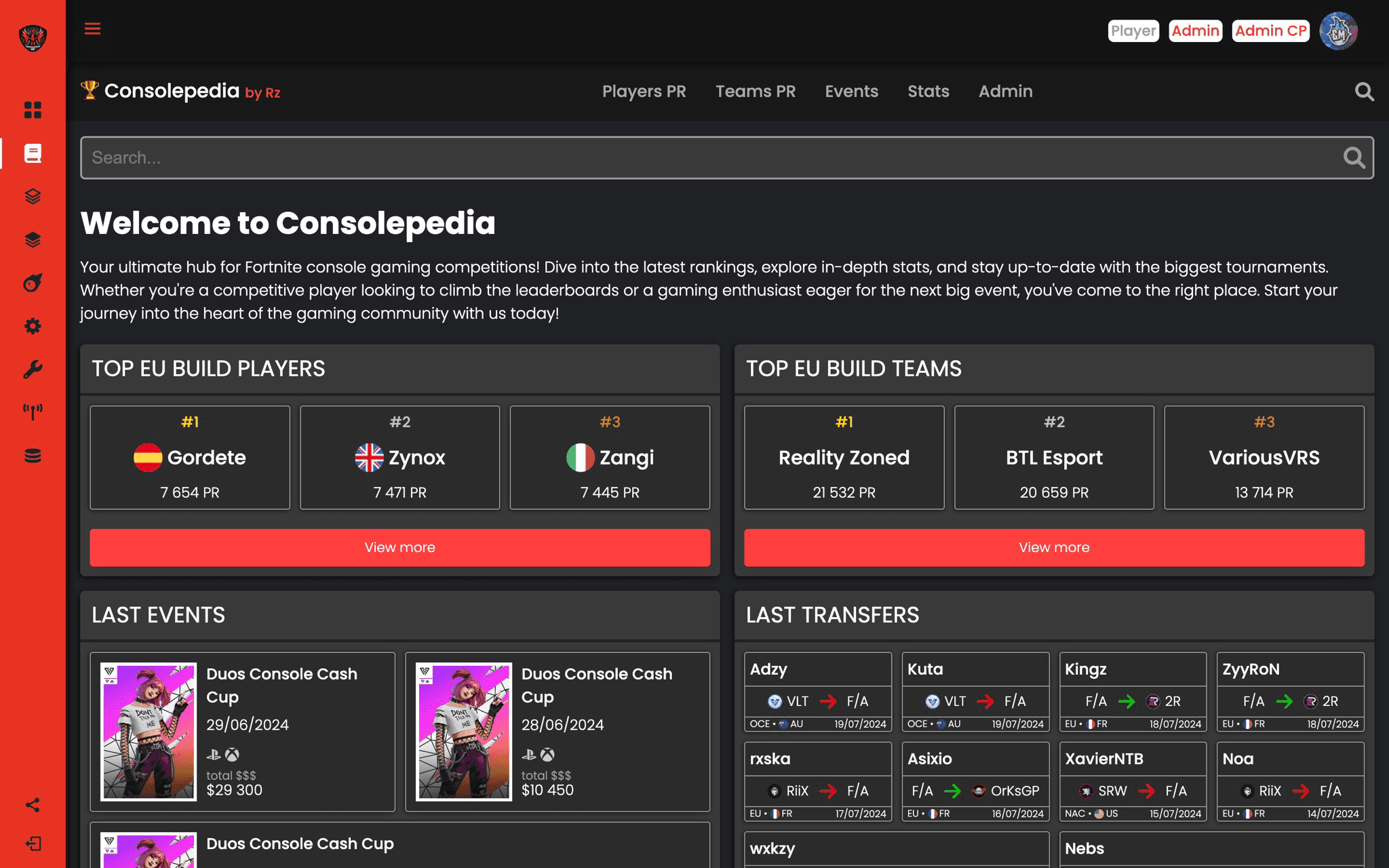
Consolepedia
Consolepedia: Building a Platform to Keep a Competitive Scene Alive
Have you ever heard of the video game Fortnite?
For several years, it has been part of the daily life of millions of players around the world, and it still is today. Beyond being a game, Fortnite became a true competitive ecosystem, with tournaments, rankings, teams, and an entire e-sports scene built around performance and comparison.
My relationship with Fortnite goes far beyond playing the game. Over time, I occupied several roles within this ecosystem: as a player, as an event organizer, as a member of an association, and as an active contributor to the console competitive community.
This project was born from that experience.
Identifying a Real Problem in the Console Competitive Scene
At a certain point, the publisher of the game decided to significantly reduce the number of official tournaments available for console players.
As a consequence, major platforms, used by millions of players to track rankings and competitive results, gradually stopped updating console performances. These websites had been essential, they allowed players to compare themselves, to follow their progress, and to highlight teams and organizations through the results achieved by their players.
Rankings were built on official tournaments, with points attributed based on final placement, tournament importance and competitive level
This system was really important to maintaining a structured competitive scene, it allows player to keep their performance in a place and easely share them. When these updates stopped, the console scene slowly lost visibility.
From Spreadsheets to a Real Platform
Within the Reality Zoned association, we initially tried to compensate for this gap ourselves. We manually tracked performances and rankings using Google Sheets, counting points by hand for each player.
It quickly became clear that this approach was, time-consuming, difficult to maintain and discouraging in the long term
That is when the idea emerged: why not create our own platform, managed by the us, for the console competitive scene?
This is how Consolepedia was born.
Building the Platform From Scratch
I started working on this project during a two-month holiday period. In reality, it represented more than 300 hours of work to reach a first functional version and this time doubled since the project’s three-year existence to maintain it and add new functionalities.
I did everything myself:
- no artificial intelligence
- no external automation tools
- learning, designing, coding, and structuring everything from scratch
This project became a major learning experience. It allowed me to significantly improve my skills in:
- PHP development
- database design and structuring
- system logic and data consistency
I designed the entire database architecture from the ground up, with one major challenge in mind: scalability and maintainability.
The Hidden Core: The Admin System
The most complex, and the part I am most proud of, is the administrative system.
It is the hidden core of the platform. Although it is private and not visible to the public, it is where everything happens.
Through this interface, staff members can:
- manage players, teams, tournaments, and seasons
- edit all stored data
- update results efficiently
- maintain the platform without technical friction
This backend was designed to make contribution easy and enjoyable. Because for a platform to stay alive, contributors must not feel exhausted by maintenance.
A Complete Competitive Ecosystem
The public side of Consolepedia includes many interconnected pages:
- Player rankings, with advanced filters (nationality, season, year, etc.)
- Team rankings, allowing teams to be compared based on collective performance
- Dedicated tournament pages, displaying:
- final standings
- points attributed
- prize money distribution
- Player profile pages, showing:
- competitive history
- points earned per season
- total earnings
- Team profile pages, including:
- roster history
- players present during specific performances
- seasonal summaries
All of this information is connected, consistent, and dynamically updated.
Automating What Is Usually Manual
One of the key innovations of the platform is the way results are added.
On many competitive websites, tournament results are entered manually after each event. This process is slow and prone to mistakes.
I designed a system that:
- retrieves data directly from the game via an API
- automatically links players to their existing profiles
- detects new players and integrates them into the database
- allows staff to validate or adjust edge cases
The goal was simple: reduce friction, reduce workload, and keep the platform sustainable over time.
More Than a Website
Consolepedia is not just a website. It is a tool designed to support a competitive ecosystem, highlight players and teams, and keep a community alive when official support fades.
It is, in many ways, my “baby”, a project I am deeply proud of.